Writing
What is imagery?
By the EssayMate.io team · Updated November 27, 2026
Short answer
Imagery is language that appeals to the senses, so that the reader can picture, hear, smell, taste or feel what is described. "Two roads diverged in a yellow wood" is visual imagery. Imagery can be literal description or work through figures of speech such as metaphor, and writers use it to create mood and to make ideas concrete.
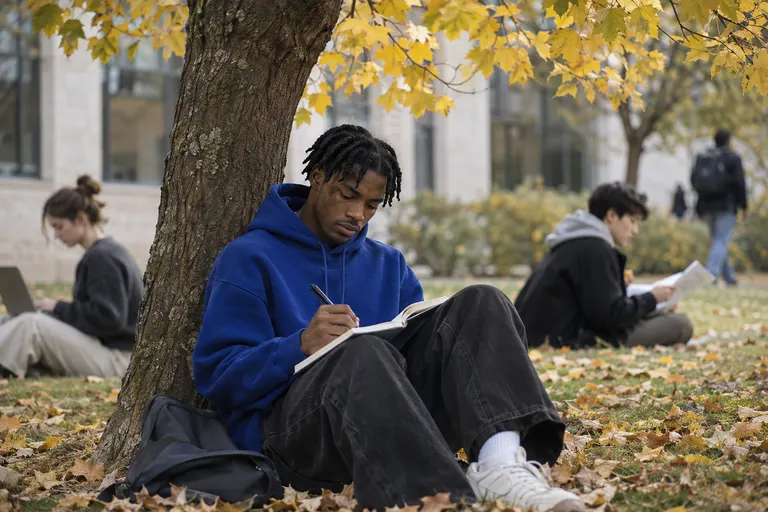
Imagery is the most common device named in literature essays and the one most often treated as decoration. It is not decoration. An image is a choice of what the reader's senses are given, and so a choice of what the reader feels.
This guide defines imagery, sets out the seven types, and shows how to move from noticing an image to saying what it does.
What does imagery mean in literature?
Imagery is the use of words to create a sensory experience in the reader's mind. Despite the name, imagery is not only visual: it covers all the senses, and the sense of movement and of the body's inner states as well. A single instance is called an image.
| Plain statement | With imagery |
|---|---|
| It was autumn. | "Two roads diverged in a yellow wood" (Frost) |
| The path had not been used. | "In leaves no step had trodden black" (Frost) |
| The kitchen was old. | The lino had worn through to the boards in front of the sink. |
| He was nervous. | His thumb found the edge of the card and bent it back and forth. |
The first two examples are from Robert Frost's "The Road Not Taken"; the last two were written for this guide. In each case the plain version tells the reader a fact, and the image gives them something to perceive, from which they work the fact out for themselves.
What are the types of imagery?
There are seven types of imagery in the usual list: five for the outward senses and two for the body.
| Type | Sense | Example |
|---|---|---|
| Visual | Sight | "a yellow wood"; "In leaves no step had trodden black" (Frost) |
| Auditory | Hearing | The gate clanged and the dogs started up along the whole street. |
| Olfactory | Smell | The hall smelled of floor polish and wet coats. |
| Gustatory | Taste | The tea was stewed and bitter, with the sweetness of tinned milk. |
| Tactile | Touch, temperature, texture | "I've heard it in the chillest land" (Dickinson) |
| Kinesthetic | Movement | "We slowly drove, he knew no haste" (Dickinson) |
| Organic | Inner bodily states: hunger, tiredness, nausea, emotion felt in the body | Her stomach dropped as the list was read out. |
Images often mix senses. Dickinson's "chillest land" is touch and sight together, and her poem about death moves at a carriage's pace so that the reader feels the slowness. Describing one sense in terms of another, such as a "loud" colour or a "sharp" taste, has its own name: synaesthesia.
Is imagery figurative language?
Imagery is not the same as figurative language, though the two overlap. Imagery is defined by its effect: it appeals to the senses. Figurative language is defined by its method: it says one thing in terms of another. An image can be completely literal.
| Line | Imagery? | Figurative? |
|---|---|---|
| "Two roads diverged in a yellow wood" | Yes: visual | No: a literal description of a wood in autumn |
| "Hope is the thing with feathers / That perches in the soul" (Dickinson) | Yes: visual and tactile | Yes: a metaphor, hope as a bird |
| "every drop of blood drawn by the lash" (Lincoln) | Yes: visual and tactile | Partly: real violence, made to stand for the whole of slavery |
| Time is money. | No: nothing to perceive | Yes: a metaphor |
So imagery is a literary device, and figures of speech such as simile, metaphor and personification are among the ways of producing it. When an image recurs through a work and gathers meaning, it becomes a motif, and when it stands for an idea, a symbol.
How do you analyse imagery in an essay? Sense, Feeling, Idea
Sense, Feeling, Idea is the three-step method we suggest. It takes you from the words to the argument.
| Step | Ask | Frost: "In leaves no step had trodden black" |
|---|---|---|
| Sense | Which sense, and which exact words create it? | Sight: "leaves", "trodden", "black". We see fallen leaves, still clean and unmarked |
| Feeling | What mood or attitude does the image carry? | Freshness and stillness; early morning, nobody yet abroad |
| Idea | What does it contribute to the meaning of the whole? | Both roads are untouched, so neither is the "less traveled" one. The image quietly contradicts the speaker's later boast |
Weak: Frost uses visual imagery to help the reader picture the scene.
Strong: The leaves on both roads are those "no step had trodden black": an image of ground still clean of footprints, which shows the reader, before the speaker claims otherwise, that neither road had been travelled more than the other.
- Quote the image exactly, and keep the quotation short.
- Comment on a single word. Why "black" and not "flat"? Why "yellow" and not "golden"?
- Look for patterns. One image is a detail; a run of images of cold, or of decay, is an argument.
- Never stop at "helps the reader picture it". That is what all imagery does. Say what this picture is for.
The full method for essays on texts is in the literary analysis essay guide, and how to quote lines of verse in how to cite a poem.
How do you write good imagery?
- Be specific. "A tree" is a word; "a cherry tree with one branch propped on a plank" is an image.
- Choose the detail that carries the feeling, and leave the rest out. Three details that agree are stronger than ten that do not.
- Use the less obvious senses. Sight is the default. Smell and sound are what make a place feel real.
- Prefer nouns and verbs to adjectives. "The gate clanged" does more than "the loud, noisy gate".
- Do not name the emotion as well. If the bent card shows the nerves, "he was nervous" is no longer needed.
- Avoid images the reader has met a hundred times: a blanket of snow, a heart of gold.
Our view: the test of an image is whether it could only belong to this scene. A sunset "painted in oranges and pinks" could be anywhere. Good imagery is less about fine writing than about having looked. More on choosing and ordering details is in how to write a descriptive essay and how to write a narrative essay.
Why do writers use imagery?
| Purpose | How imagery does it |
|---|---|
| To set a mood | Cold, grey, quiet details make a reader uneasy before anything happens |
| To make an abstract idea concrete | Dickinson gives hope feathers and a perch |
| To reveal a character | What a narrator notices tells you who they are |
| To persuade | Lincoln makes his audience see blood, not "the costs of slavery" |
| To slow the reader down | A described moment takes longer to read, and so feels more important |
| To prepare a meaning | An image early in a work can return later with more weight |
Other devices have their own guides: allusion, juxtaposition and personification. For persuasion through feeling, see ethos, pathos and logos.
Frequently asked questions
What is imagery in simple terms?
Imagery is descriptive language that lets a reader experience something through the senses: seeing, hearing, smelling, tasting or feeling it in the mind.
What are the five types of imagery?
The five main types match the five senses: visual (sight), auditory (hearing), olfactory (smell), gustatory (taste) and tactile (touch). Two more are often added: kinesthetic, for movement, and organic, for inner bodily feelings.
Is imagery only visual?
No. Although the word suggests pictures, imagery covers every sense. A description of a sound, a smell or the feel of cold water is imagery too.
Is imagery a literary device?
Yes. Imagery is a literary device used in poetry, fiction, drama and speeches. It is often produced by other devices, such as metaphor and simile, but it can also be plain literal description.
What is the difference between imagery and symbolism?
Imagery appeals to the senses; it lets you perceive something. Symbolism gives an object a meaning beyond itself. An image becomes a symbol when it stands for an idea, as a road may stand for a choice in life.
What is an example of imagery in poetry?
The opening line of Robert Frost's The Road Not Taken, Two roads diverged in a yellow wood, is visual imagery. In four words about colour and place it gives the season and the setting.
Keep going